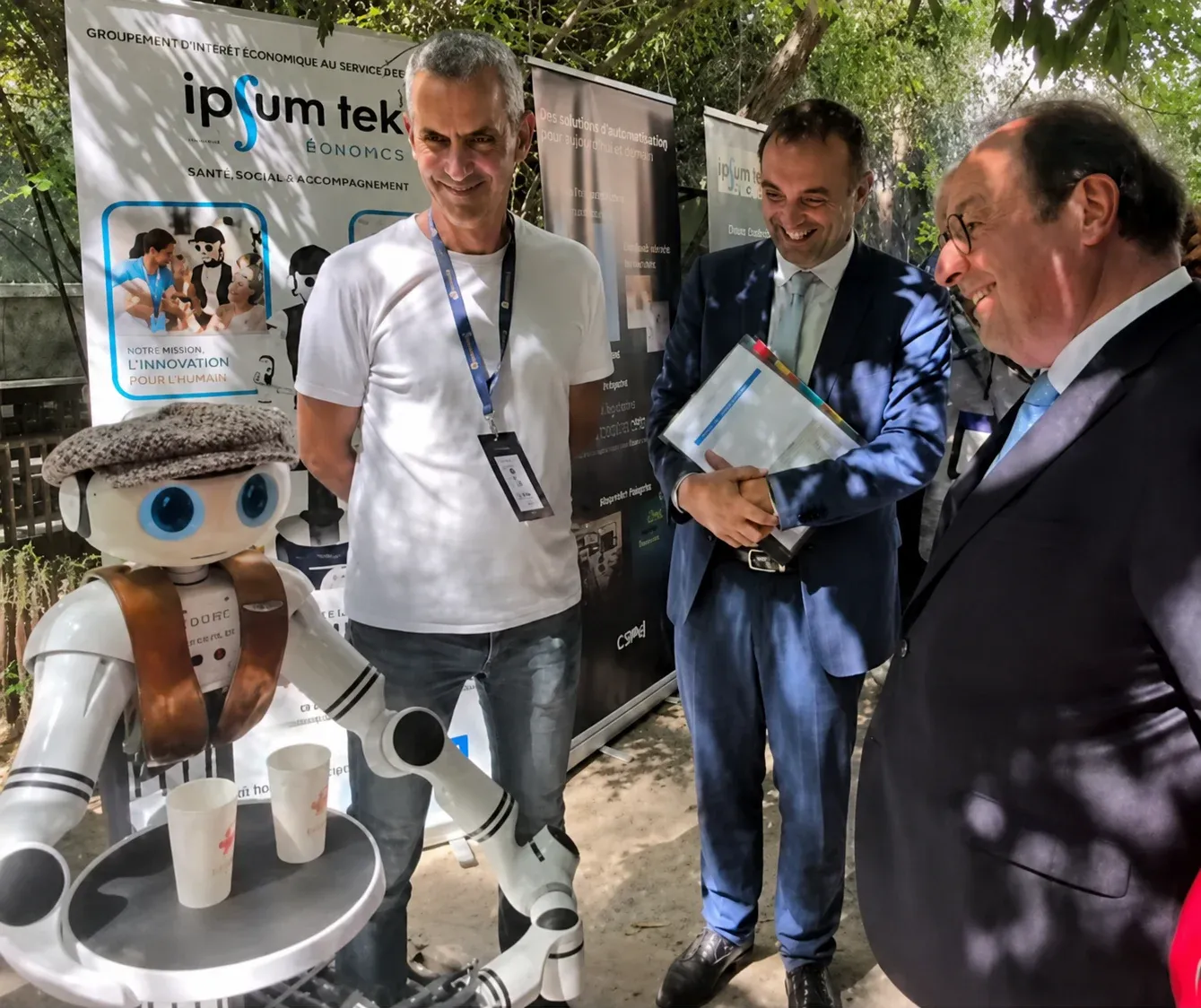
We were at Hello La Tech, and our humanoid robot ONYRO caught the attention of a former President of the French Republic.
To be honest, we knew he was expected to pass by, and we had taught ONYRO to recognize him. What we had not planned was the small moment of humor: ONYRO answered, discussed, and sometimes took the initiative on its own.
A few days later, we were invited to present ONYRO at the Rencontres de la Silver Economie. The challenge is major: our population is aging, and in less than fifteen years, more than one French person in four will be 65 or older. This subject matters deeply to me. I created Ipsum Tek in 2020 with a deliberately avant-garde project: to give every elderly person both a butler and a guardian angel.
An article on pusillanimous France struck me even more because a recent anecdote from our own fundraising work illustrates it perfectly. We had asked a company to support our fundraising and deck preparation. The version I proposed was ambitious: it presented our industrial mobile robots, already backed by rare traction in this sector, but also ONYRO, our humanoid robot dedicated to the silver economy and services, a nearly unique case in France.
That ambition became a problem. I was told: ONYRO, no. With that robot, you will scare everyone.
So we removed it from the deck, even though it represented a considerable growth path for the company.
Perhaps this is the real subject: it is not always failure that scares us. Sometimes it is ambition itself.
Bernard Froment, CEO, Ipsum Tek
Two legs to be useful?
Humanoids are back in force. They shine. They impress. But in a workshop, a warehouse, or a factory, do we really need a robot that looks like us?
Often, the need is simpler: transport, repeat, secure, relieve, without adding complexity.
A robot does not need to look human to serve humans. The future will not necessarily be humanoid. It will above all be pragmatic.
We have become pusillanimous
An old forgotten word, and yet so current.
The intention behind writing the precautionary principle into the French Constitution was noble. But little by little, that principle seems to have slid toward a culture of fear. By wanting to frame and secure everything, we have stopped daring.
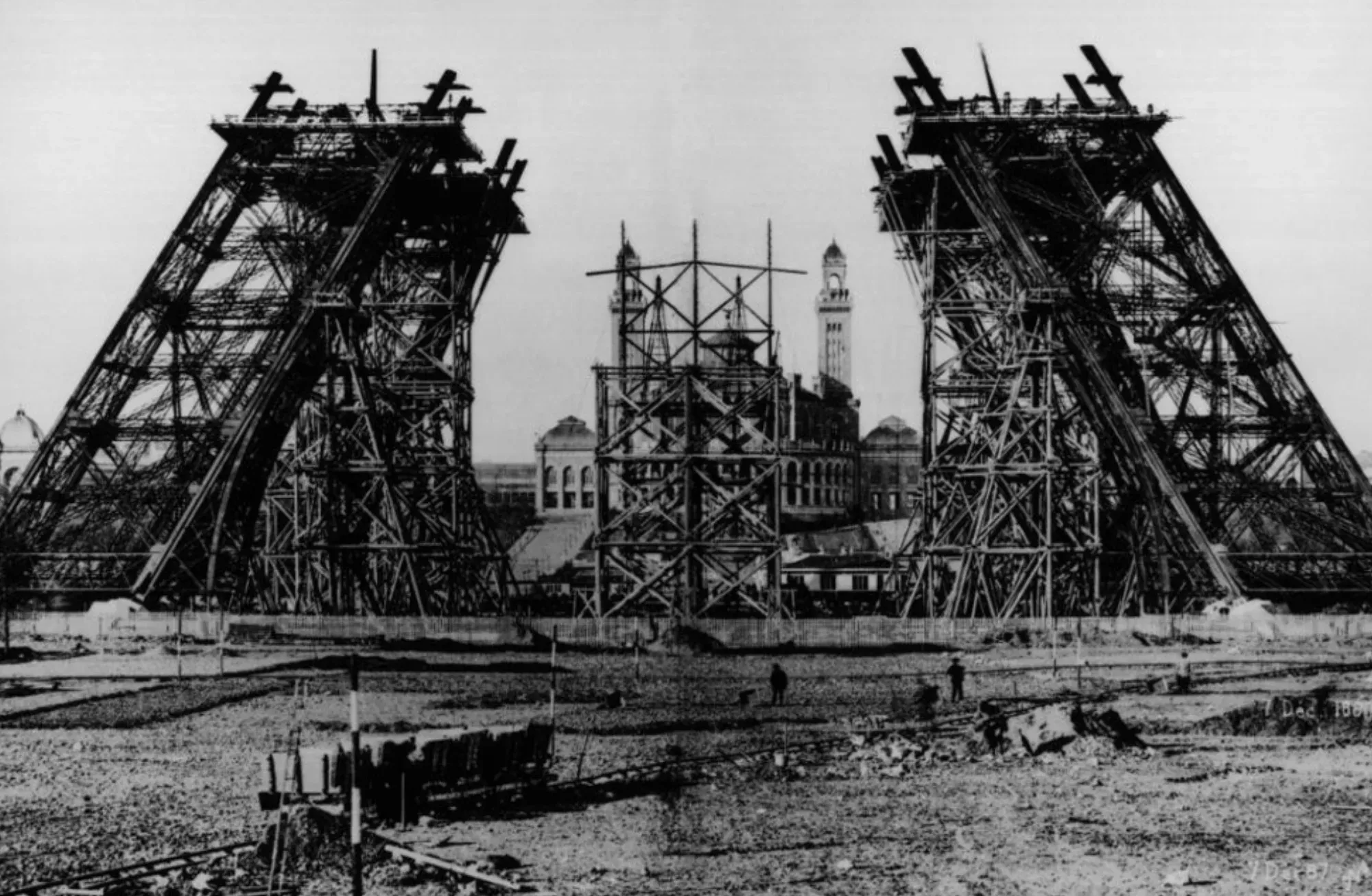
Yet our history was built by people who took risks: Gustave Eiffel, mocked before his tower became a symbol of French genius; Louis Pasteur, challenging certainties to save lives; Clement Ader, dismissed as a dreamer before opening the path to aviation; Marie Curie, risking her life, and many others. None of these minds could have emerged in a society without audacity.
Today, while others innovate, explore, and sometimes fail so they can begin again, we debate what would be better to avoid. We legislate and we doubt.
Risk is the engine of progress. Its vital energy. France has not lost its talents. It has lost its capacity to take risks. From pioneer, it has become follower. What if everything started there, with our collective fear of risking?
Digital sovereignty: saying one thing and doing the opposite
While the French state pushes administrations toward trusted solutions for sensitive data, the Ministry of Education has extended its Microsoft framework agreement until 2029, for a reported maximum amount of around 152 million euros excluding tax. The contradiction reopens the debate: can we really speak of digital sovereignty when some critical dependencies remain so strong?
Sovereignty is not declared, it is designed. In robotics, that means mastering software, data, updates, supervision, and the full lifecycle, not a decorative sovereignty label.
An autonomous robot is also an attack surface
ANYbotics reminds us that field robots connected to Physical AI handle sensitive data: site maps, inspection results, machine states, anomalies, and operational information, sometimes from critical environments.
That is exactly why sovereignty cannot be a marketing veneer. In an AMR, you need to know where data goes, who can access the robot, how updates are deployed, what can be controlled remotely, and what must never be. That is the spirit of FlexCruiser-AS: security and control designed in from the start.
When the machine seems to think, our brain lowers its guard
In the ARTE documentary How our brain tricks us, A. Moukheiber reminds us that our brain does not see reality as it is. It filters, simplifies, and interprets. These mechanisms help us live, decide, and trust, but they can also mislead us.
With AI, the trap becomes subtler. A machine that speaks well, answers quickly, and sounds confident can give the impression that it understands. Yet it remains uncertain: it can be wrong, reproduce biases, and influence our choices with disarming confidence.
The question is not to become suspicious of machines, but to rebuild the foundations of trust. Trusting does not mean believing blindly. It means understanding limits, questioning, cross-checking, and accepting that we think with others.
Source: How our brain tricks us, ARTE documentary in two episodes, directed by Vincent Amouroux.
In autonomous robotics, this trust must be built. A robot should not reassure because it impresses, but because its behavior is tested, documented, predictable, and controllable. Behind every machine are humans who will have to live with its decisions: operators, technicians, caregivers, patients, and field teams. Our responsibility is simple: design robots whose capabilities, limits, and risks are understood. A good robot is not a machine we believe in. It is a machine around which humans can continue to think, decide, and trust one another.
OUR NEWS
Global Industrie: field feedback with an Ipsum Tek AMR
A robot. An industrial trade show. Crowded aisles. Noise. Unplanned events. In short: the real field.
This year, we were at Global Industrie with our distributor Metronelec. Rather than stay with a perfect demo, we did what we prefer: put our AMR into real life.
Navigating among visitors, handling changing flows, avoiding unexpected obstacles, staying fluid and readable: this is exactly where autonomy is judged, when nothing happens as planned.
Many thanks to Metronelec for the welcome, energy, and presence on the stand.
ONYRO at Hello La Tech in Montpellier
New setting: Montpellier, Hello La Tech, May 28. We presented ONYRO, our mobile humanoid robot, and above all our vision: useful, concrete, sovereign French robotics designed to support humans, caregivers, care teams, and field teams.
A standout moment: ONYRO was presented to Francois Hollande and Michael Delafosse, with the blend we like: serious, and a little humor.
Many thanks to La French Tech Mediterranee for the spotlight, welcome, and organization of the event, and for making those direct exchanges with the public possible.
ONYRO at the Rencontre de la Silver Economie
ONYRO, the silver economy, and a simple question: how do we really help?
On June 2, we attended the Rencontre de la Silver Economie at the CCI Nice Cote d'Azur. It was an opportunity to present ONYRO in real conditions: autonomous movement, interaction with visitors, and answers to questions.
It was an important moment to share our vision of useful, concrete, reassuring French robotics serving healthy aging, autonomy, and field teams. Thank you to the CCI Nice Cote d'Azur for the welcome and the quality of the exchanges.